
What is the Dhyangro?
The Dhyangro is far more than a drum.
For centuries, it has been at the heart of Nepalese shamanic practice, used by the Dhami-Jhankri — indigenous healers who serve as intermediaries between the visible and invisible worlds. In their hands, the drum becomes a living instrument of transformation, capable of opening pathways between reality as we perceive it and the deeper layers that exist beyond it.
Its sound is not simply heard. It is felt, followed, and entered.
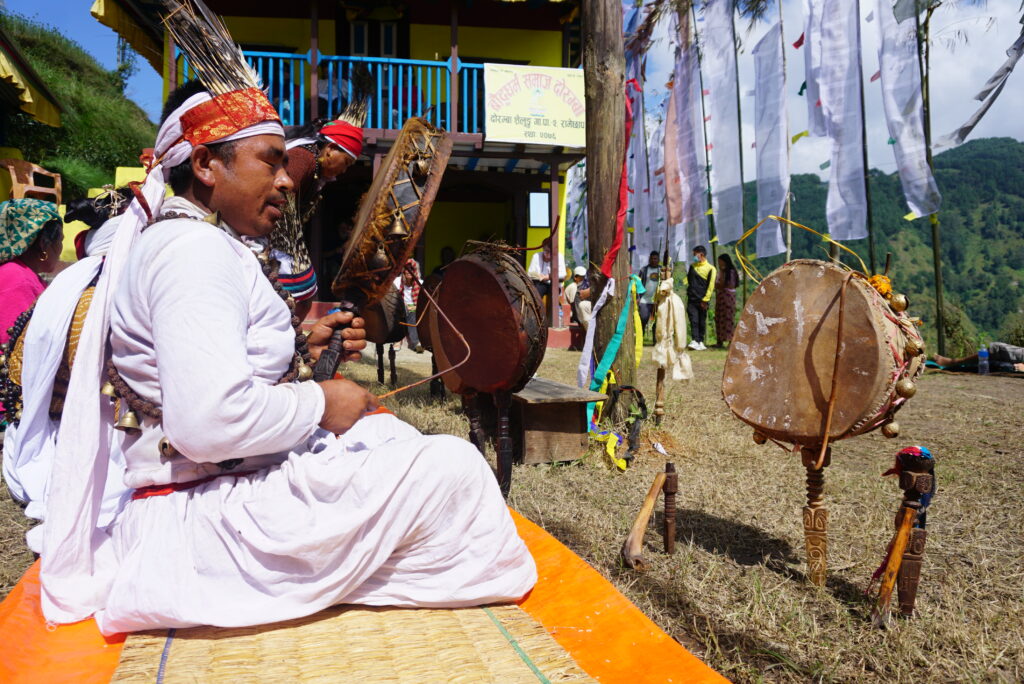
The nepalese sacred drum: Dhyangro
Credit photo: Energia Spirit / Celine G.
A Drum That Holds a Cosmology
To understand the Dhyangro is to understand that nothing in this tradition is decorative or accidental. Every element of the drum carries meaning.
Its two heads reflect the fundamental duality of existence — masculine and feminine, active and receptive forces that must be brought into balance. The handle, often carved in the form of a Kila (a ritual dagger), represents spiritual authority and the power to cut through illusion or disturbance. Symbols such as deity faces, endless knots, and serpent motifs are not ornamental; they encode a worldview in which everything is interconnected, alive, and in constant relationship.
The drum itself becomes a map of the universe — one that the shaman must learn not only to read, but to navigate.
The Three Realms: A Living Universe
In Nepalese shamanism, reality is not limited to what can be seen.
Existence is understood as a dynamic interplay between three realms: the upper world of celestial beings and guiding forces, the middle world of humans, nature, and everyday life, and the lower world, where ancestral spirits and deeper unconscious energies reside.
These realms are not separate in the way modern thinking might imagine. They overlap, influence one another, and remain in constant dialogue.
When a Jhankri enters trance, they are not escaping reality — they are moving through it, crossing thresholds that most people are not trained to perceive.
Entering the Jhaak: The State of Trance
Everything begins with rhythm.
The steady beat of the Dhyangro gradually reshapes awareness. What starts as sound becomes a pulse, and what begins as attention turns into immersion. Chanting rises alongside the drum, weaving layers of vibration that draw the mind away from ordinary perception and into something more fluid, more expansive.
This altered state, known as Jhaak, is not symbolic or theatrical. It has a measurable physiological basis. Repetitive rhythms synchronize brain activity, guiding it into patterns associated with deep relaxation, heightened intuition, and vivid inner imagery.
This process, often described as brainwave entrainment, allows the boundaries between analytical thinking and intuitive perception to soften. The result is a state in which the shaman can perceive, interpret, and interact with subtle dimensions of experience.
From the outside, it may appear intense: the body moves, the breath changes, the voice shifts. But from within, it is a precise and trained navigation of consciousness.
Healing as Restoration of Balance
In this tradition, illness is rarely seen as random.
Instead, it is understood as a disruption in the wider field of relationships that make up reality. Nature, spirits, ancestors, and human beings are all part of a single living system. When something falls out of balance — whether through emotional trauma, spiritual disturbance, or environmental disharmony — the effects can manifest as physical or psychological distress.
The role of the shaman is not simply to treat symptoms, but to identify where this imbalance originates and to restore harmony at its source.
This may involve communicating with spiritual forces, retrieving lost aspects of the self, or releasing energies that no longer belong. The Dhyangro guides this process, its rhythm acting as both anchor and pathway.
When the Ancestors Speak
One of the most profound aspects of Nepalese shamanism is its relationship with those who have passed on.
In a practice known as Chinta, the boundary between the living and the dead becomes permeable. The shaman may allow an ancestral spirit to briefly express itself through their body, offering messages, guidance, or simply the presence that was once lost.
For those witnessing it, this can be deeply moving. Grief finds a voice. Unfinished conversations find space. What seemed distant becomes immediate again.
It reflects a simple but powerful understanding: the dead are not absent — they remain part of the fabric of life.
A Collective Experience of Transformation
Although the shaman guides the ritual, the experience is never individual.
As the drumbeat deepens and the trance unfolds, something begins to shift within the entire group. Emotions surface, tensions release, and a shared field of awareness emerges. The ceremony becomes a container — one that allows what is often hidden or unspoken to be expressed and transformed.
In this space, the usual boundaries between self and others soften. Healing is not something that happens in isolation, but as part of a collective recalibration.
The steady pulse of the Dhyangro holds it all together, like a heartbeat that belongs to everyone present.
More Than a Ritual: A Way of Seeing the World
The Dhyangro is not just a tool used in ceremony. It represents an entire way of understanding existence.
It reminds us that we are not separate from nature, that the visible world is only part of the story, and that balance — both within ourselves and in our relationships — is essential to wellbeing.
Its rhythm echoes something deeply familiar, yet often forgotten. Something that does not need to be explained to be recognized.
Experience It for Yourself
Reading about this tradition offers a glimpse. Experiencing it is something else entirely.
From June 25–28th 2026, in the mountains of Cercedilla (Madrid, Spain), you are invited to step into this ancient practice and encounter it directly.
👉 Discover more and reserve your place for our next retreat.
Frequently Asked Questions
What is the Dhyangro used for?
It is used by Nepalese shamans to enter trance, create an anchor and a protection, communicate with spiritual realms, and facilitate healing.
Can participants benefit without being shamans?
Yes. Participants often experience emotional release, clarity, and a deep sense of connection.
What makes Nepalese shamanism unique?
Its continuous lineage, strong connection to nature and ancestors, and structured understanding of multiple realms set it apart from many other traditions.