🌸 Holi in Nepal: sacred spring ritual and renewal

🌞 What is Holi in Nepal?

In Nepal, Holi is called Fagu Poornima. This festival takes place during the full moon, in the Hindu calendar month Phagun, that is between early March and early April.

It marks the end of the long winter months. The return of the sun and higher temperatures corresponds to this moment of celebration.

Thus, Holi celebrates the growing light and the renewal of nature.

🔥 The fire ceremony: celebrating the light

First of all, a fire ceremony takes place on the night preceding the celebrations.

In each village, a large pile of wood is built. Each household brings logs to form a collective fire.

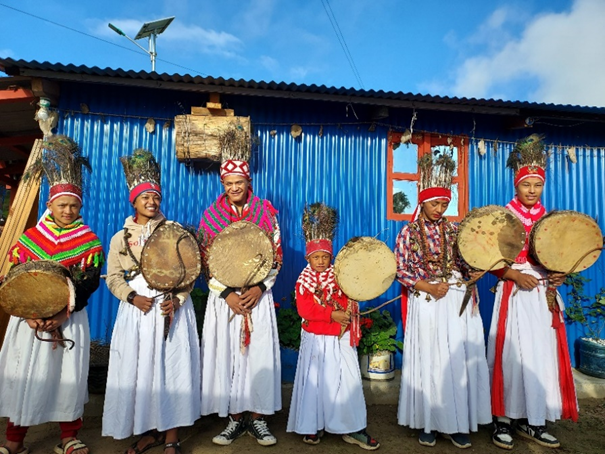
The oldest person in the village, or the one who leads the ceremony, lights the fire. This can be a dhami – jhankri, a Nepalese shaman.

Around the flames, the community gathers. Participants play traditional music with drums and trumpets. Then, voices rise and accompany the dances around the fire.

This moment allows to:

  • let go of darkness and cold
  • bring healing energies
  • strengthen bonds within the community

🏵️ The sacred pole ritual in Kathmandu

In Kathmandu, the festival begins with the raising of a ceremonial pole called chir. This pole is made from a pine tree cut in the district of Bhaktapur. It is then transported in ceremony to Kathmandu. It is erected in Basantapur, on Durbar Square.

The top of the pole is surrounded by strips of colored fabric. At its base, oil lamps are lit and placed on a ground covered with cow dung.

Participants also tie colored threads around the trunk.

This pole symbolizes both the union of masculine and feminine energies and a banner of victory to welcome spring.

The fabrics represent the garments of the Gopinis (devotees of Krishna).
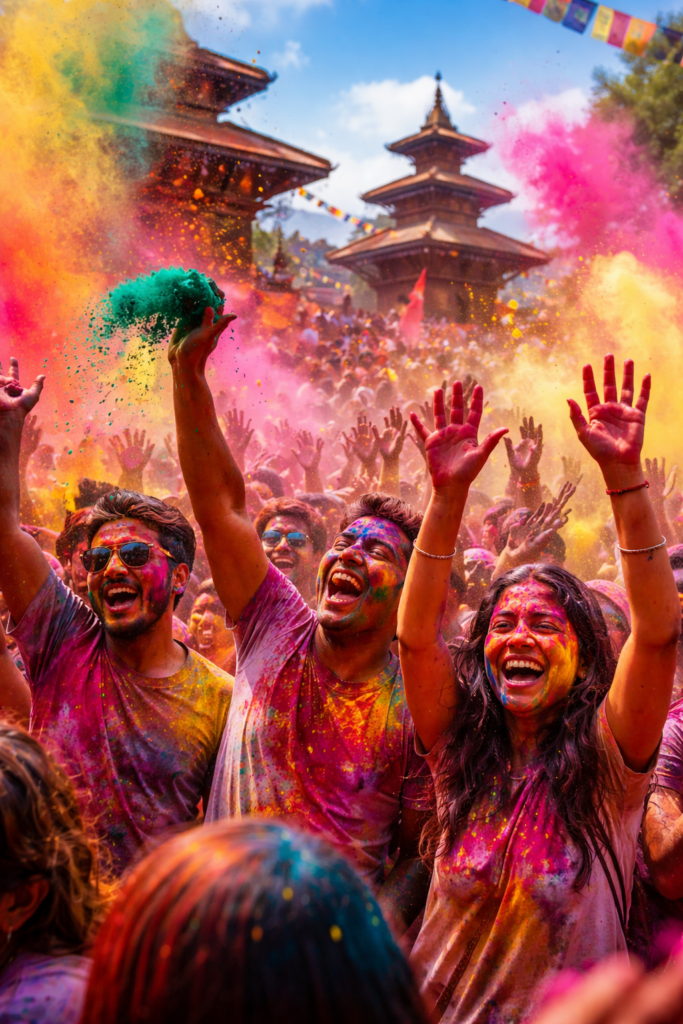
Festival of colors during Holi celebrations in Nepal

🌈 The day of colors: celebrating life

The next day, the festival becomes joyful and colorful. It celebrates the defeat of darkness by the forces of light.

It also symbolizes the union of Earth, Dharti Mata, and Sky, Akash. This union marks the season of fertility of nature.

To celebrate this moment, participants throw colored powders at each other. They move in small groups and cover themselves with colors.

🔥 The final of the festival: fire and protection

At the end of the festival, the pole is lowered.

The crowd rushes to collect the strips of fabric. They are considered protective amulets against evil spirits.

Then, the pole is transported to Tundikhel, a large square in Kathmandu. It is burned in a large fire, into which women throw coconuts.

Finally, participants bring home embers and ashes to purify their house.

📜 What is the origin of Holi in Nepal?

Holi was originally a festival celebrating spring, good harvests and fertility.

The first mentions date back to the 4th century. It is also described in a 7th-century Sanskrit play titled Ratnavali, written by Harsha.

Today, Holi is mainly associated with several legends of Hindu mythology.

The first legend is that of Holika and Prahlada, children of Hiranyakasyapu.

Hiranyakasyapu considered himself the most powerful being in the universe and wanted everyone to worship only him. Prahlada, on the other hand, was a devotee of the god Vishnu.

Hiranyakasyapu tried many times to convince his son to worship him, but failed miserably. Prahlada therefore continued to worship the god Vishnu. He tried to kill him several times, without success.

Hiranyakasyapu then plotted to assassinate his 5-year-old son. He ordered Holika, his sister, to kill Prahlada. Holika was supposed to be protected from fire thanks to a fireproof robe. And finally, she took Prahlada into the flames.

However, because of his faithful devotion to the god Vishnu, the god Krishna came to his rescue: the prince came out unharmed, while Holika burned in his place.

Holika Dahan, which means “the end of Holika”, is today known as Holi. People still celebrate the death of Holika with colors. They make a straw replica of Holika and burn it during the Holi festival.

💕 The story of Krishna and Radha

It is said that Krishna constantly complained to his mother, Yasodha, and that all his friends teased him by calling him “the dark one” (Kala).

It is said that he asked Yasodha why he was dark while all his friends (the Gopinis, including his beloved Radha) had fair skin.

Yasodha then gave Krishna different colors and asked him to throw them on the faces of all the Gopinis so that they too would have dark skin like him.

Krishna brought the colors and applied them to all the Gopinis. The Gopinis loved these colors, as they were all deeply in love with Krishna and enjoyed this moment.

This is one of the legends explaining the use of colors during Holi festivities.

Today, colors symbolize:

  • blue for Krishna
  • red for love and fertility
  • green for spring and renewal
  • yellow for turmeric and prosperity

🌿 Create your own renewal ceremony

This ceremony can be performed at the beginning of spring or at any time when you wish to mark the end of one cycle and the beginning of another.

It can celebrate:

  • the end of an important project
  • a new relationship
  • a birth
  • a return to health

It is about honoring these events and the renewal that accompanies them.

You can choose to celebrate this passage alone or with your loved ones.

🌍 In conclusion, Holi in Nepal…

Holi is the most colorful festival in Nepal, and very probably on the continent.

It celebrates renewal, light and the cycles of life. Through fire, colors and rituals, it marks the passage toward a new beginning.


❓ FAQ / Frequently Asked Questions – Holi in Nepal

When does Holi take place in Nepal?
Holi takes place during the full moon, in the Hindu calendar month Phagun, between early March and early April.

What does Holi symbolize?
Holi symbolizes the return of light, fertility and renewal.

Why is a fire lit?
The fire commemorates the death of Holika and symbolizes purification.

Why are colors used?
Colors celebrate fertility, joy and the legend of Krishna and Radha.
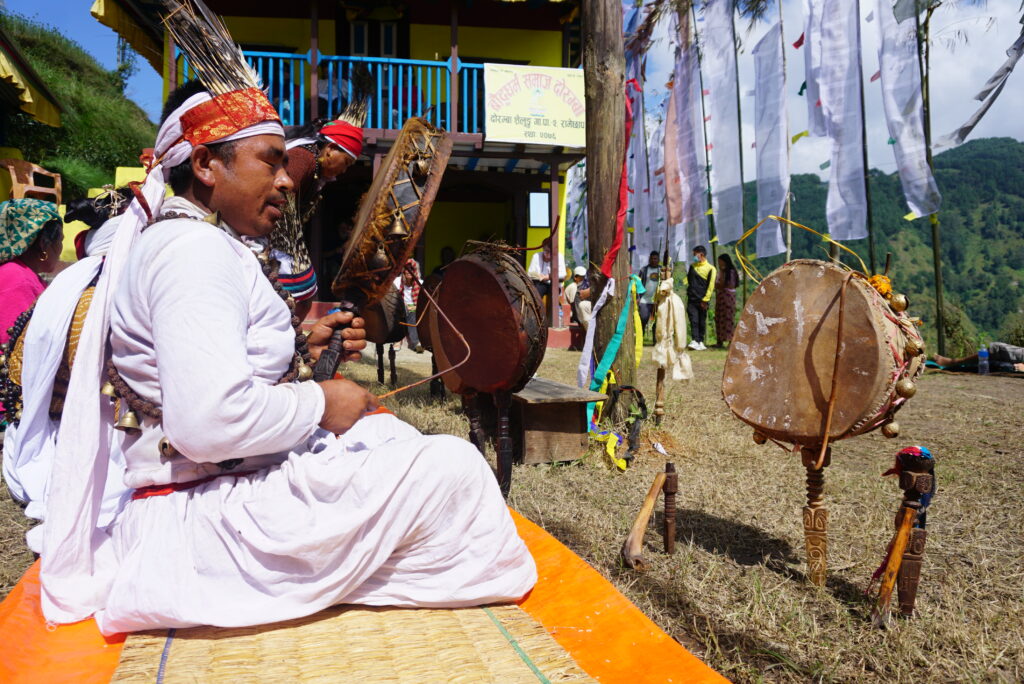
The Dhyangro: The Sacred Drum That Bridges Worlds in Nepalese Shamanism

What is the Dhyangro?

The Dhyangro is far more than a drum.

For centuries, it has been at the heart of Nepalese shamanic practice, used by the Dhami-Jhankri — indigenous healers who serve as intermediaries between the visible and invisible worlds. In their hands, the drum becomes a living instrument of transformation, capable of opening pathways between reality as we perceive it and the deeper layers that exist beyond it.

Its sound is not simply heard. It is felt, followed, and entered.


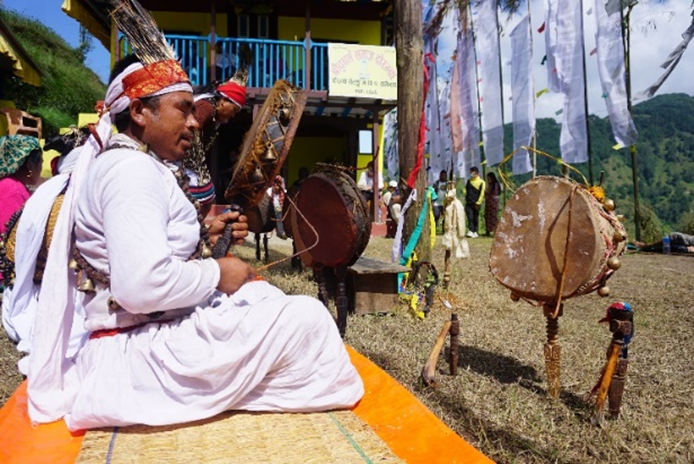
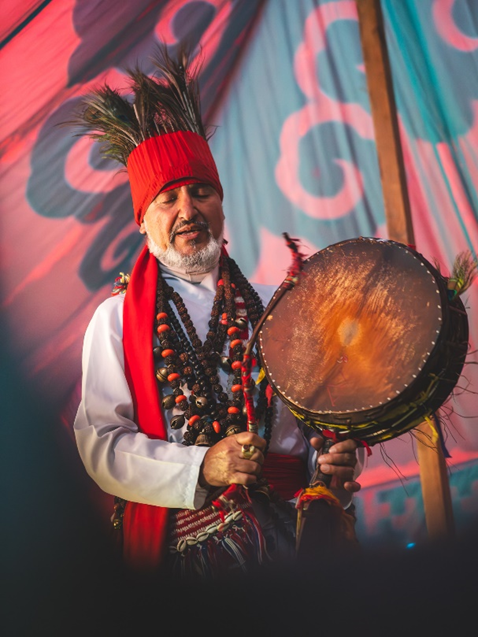
A Dhami jhankri, nepalese shaman playing the sacred drum, Dhyangro

The nepalese sacred drum: Dhyangro

Credit photo: Energia Spirit / Celine G.

A Drum That Holds a Cosmology

To understand the Dhyangro is to understand that nothing in this tradition is decorative or accidental. Every element of the drum carries meaning.

Its two heads reflect the fundamental duality of existence — masculine and feminine, active and receptive forces that must be brought into balance. The handle, often carved in the form of a Kila (a ritual dagger), represents spiritual authority and the power to cut through illusion or disturbance. Symbols such as deity faces, endless knots, and serpent motifs are not ornamental; they encode a worldview in which everything is interconnected, alive, and in constant relationship.

The drum itself becomes a map of the universe — one that the shaman must learn not only to read, but to navigate.


The Three Realms: A Living Universe

In Nepalese shamanism, reality is not limited to what can be seen.

Existence is understood as a dynamic interplay between three realms: the upper world of celestial beings and guiding forces, the middle world of humans, nature, and everyday life, and the lower world, where ancestral spirits and deeper unconscious energies reside.

These realms are not separate in the way modern thinking might imagine. They overlap, influence one another, and remain in constant dialogue.

When a Jhankri enters trance, they are not escaping reality — they are moving through it, crossing thresholds that most people are not trained to perceive.


Entering the Jhaak: The State of Trance

Everything begins with rhythm.

The steady beat of the Dhyangro gradually reshapes awareness. What starts as sound becomes a pulse, and what begins as attention turns into immersion. Chanting rises alongside the drum, weaving layers of vibration that draw the mind away from ordinary perception and into something more fluid, more expansive.

This altered state, known as Jhaak, is not symbolic or theatrical. It has a measurable physiological basis. Repetitive rhythms synchronize brain activity, guiding it into patterns associated with deep relaxation, heightened intuition, and vivid inner imagery.

This process, often described as brainwave entrainment, allows the boundaries between analytical thinking and intuitive perception to soften. The result is a state in which the shaman can perceive, interpret, and interact with subtle dimensions of experience.

From the outside, it may appear intense: the body moves, the breath changes, the voice shifts. But from within, it is a precise and trained navigation of consciousness.


Healing as Restoration of Balance

In this tradition, illness is rarely seen as random.

Instead, it is understood as a disruption in the wider field of relationships that make up reality. Nature, spirits, ancestors, and human beings are all part of a single living system. When something falls out of balance — whether through emotional trauma, spiritual disturbance, or environmental disharmony — the effects can manifest as physical or psychological distress.

The role of the shaman is not simply to treat symptoms, but to identify where this imbalance originates and to restore harmony at its source.

This may involve communicating with spiritual forces, retrieving lost aspects of the self, or releasing energies that no longer belong. The Dhyangro guides this process, its rhythm acting as both anchor and pathway.


When the Ancestors Speak

One of the most profound aspects of Nepalese shamanism is its relationship with those who have passed on.

In a practice known as Chinta, the boundary between the living and the dead becomes permeable. The shaman may allow an ancestral spirit to briefly express itself through their body, offering messages, guidance, or simply the presence that was once lost.

For those witnessing it, this can be deeply moving. Grief finds a voice. Unfinished conversations find space. What seemed distant becomes immediate again.

It reflects a simple but powerful understanding: the dead are not absent — they remain part of the fabric of life.


A Collective Experience of Transformation

Although the shaman guides the ritual, the experience is never individual.

As the drumbeat deepens and the trance unfolds, something begins to shift within the entire group. Emotions surface, tensions release, and a shared field of awareness emerges. The ceremony becomes a container — one that allows what is often hidden or unspoken to be expressed and transformed.

In this space, the usual boundaries between self and others soften. Healing is not something that happens in isolation, but as part of a collective recalibration.

The steady pulse of the Dhyangro holds it all together, like a heartbeat that belongs to everyone present.


More Than a Ritual: A Way of Seeing the World

The Dhyangro is not just a tool used in ceremony. It represents an entire way of understanding existence.

It reminds us that we are not separate from nature, that the visible world is only part of the story, and that balance — both within ourselves and in our relationships — is essential to wellbeing.

Its rhythm echoes something deeply familiar, yet often forgotten. Something that does not need to be explained to be recognized.


Experience It for Yourself

Reading about this tradition offers a glimpse. Experiencing it is something else entirely.

From June 25–28th 2026, in the mountains of Cercedilla (Madrid, Spain), you are invited to step into this ancient practice and encounter it directly.

👉 Discover more and reserve your place for our next retreat.


Frequently Asked Questions

What is the Dhyangro used for?
It is used by Nepalese shamans to enter trance, create an anchor and a protection, communicate with spiritual realms, and facilitate healing.

Can participants benefit without being shamans?
Yes. Participants often experience emotional release, clarity, and a deep sense of connection.

What makes Nepalese shamanism unique?
Its continuous lineage, strong connection to nature and ancestors, and structured understanding of multiple realms set it apart from many other traditions.

Ostara / Eostre: The Arrival of Spring in the Celtic Calendar

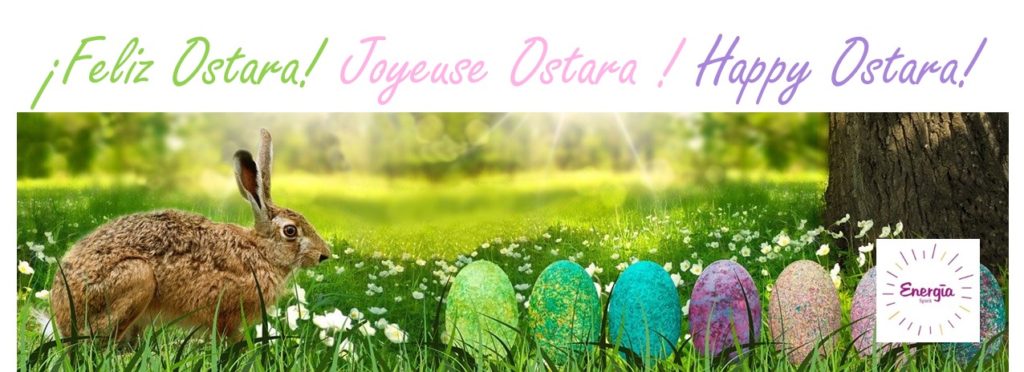
Around March 20, in the Northern Hemisphere, we celebrate the return of spring. It is a moment that marks the balance between day and night, the equinox. It is also the return of light and the return of the earth’s fertility, with the first shoots beginning to emerge from the ground, buds timidly appearing on the branches of shrubs and trees, chicks leaving their nests, and hares leaping into the grass to court one another. Light triumphs over darkness. The days are sweeter, longer, and livelier. Energy and passion are two other symbols of this period. The two polarities—feminine (moon-night) and masculine (sun-day)—balance each other and unite to make life fruitful.

ostara

After a harsh winter, the rebirth of life and the Earth is associated with the Anglo-Saxon goddess of fertility: Eostre, often linked to the goddesses of the Dawn—Aurora for the Romans and Eos for the Greeks. These goddesses were thus entrusted with the task of ushering in the morning, letting in the light of day. As a symbol of Dawn and Aurora, the associated direction is, in fact, the East.

The Spring Equinox is also associated with the Germanic goddess Ostara, whose name derives from the word “ost,” meaning “East.” Ostara is the goddess of fertility, the earth, nature, and youth.

The animals associated with this period of fertility are chicks, young rabbits, ducklings, and young animals. The rabbit or hare, formerly associated with the moon, is also a symbol of fertility.

The colors associated with Ostara are the yellow of the sun and the green of nature.

Rituals tailored for these days of renewal

  • Spring cleaning began with Imbolc in early February. Now is the time to finish that big house cleaning—in every area of your life and on every level—by sweeping away stagnant and even harmful energies. So grab your broom and sweep away, both symbolically and physically, whatever you no longer need from inside your house or apartment. Sweep each room with the broom, starting from the corners opposite the door, to sweep them toward the room’s doorway, and then sweep them out through the front door with gratitude. Next, you can burn incense (Copal, Benzoin…) or smudge with white sage, rosemary, etc., in each room, and then air them out. And don’t forget to pass the sage or incense around yourself as well to free yourself too.
  • The celebration of life and fertility comes to life with eggs that you can paint in vibrant colors. Once used in sacred rituals before being eaten, eggs represent the genesis of the world, where life emerges from darkness to discover the light.
  • To celebrate the Earth’s awakening in the coming days, you can also take a walk in nature, barefoot, gather the first fresh flowers of the year, and express your gratitude for their blooming, their blossoming. Observe the buds emerging, listen to the buzzing of insects. You can also tend to your garden, plant seeds, or simply enjoy the warmth of the sun. In any case, take this moment to ground yourself, and take a long, deep breath to welcome this renewal.
  • Ostara is also an ideal time to spark new projects, to create, to initiate change. So take your best pen and draw your desires, affirm your desires, decree your desires. Do this by including as many details as possible: date, place, images, sound, sensation, surroundings…
  • Take a moment to meditate while sitting or lying under a tree and enjoy the present moment, observing your surroundings, smiling at life.

#ostara #eostre #ancestraltradition #rebirth #growth #life #fertility #nature #equinox #spring

 🌿Awen: The Power of the Sacred Celtic Breath

🧠 A Brief Definition of “Awen”

Awen is a Celtic concept that refers to a breath of divine inspiration. It symbolizes a creative spiritual energy that connects humans with nature and the divine, and plays a fundamental role in the tradition of the bards and druids..

⏱️ Reading time: 6-8 min

✨Introduction: Awen, an Ancestral Breath That Lives On

The concept of Awen is one of the most fascinating pillars of Celtic spirituality. At once poetic inspiration, creative force, and divine breath, it has endured through the centuries, from the oral traditions of the bards to contemporary Neo-Druidic practices.

But Awen is not limited to a simple spiritual idea: it constitutes a genuine bridge between the human, nature, and the divine, as studied in medieval texts.

📜 Origins: Between Ancient Texts and Oral Tradition

📖 The earliest written records

Awen appears as early as the 9th century in Nennius’s *Historia Brittonum*, where it is associated with the figure of Talhaern Tad Awen, highlighting its importance in the Welsh bardic tradition.

But it is above all in the Book of Taliesin (13th–14th centuries) that the concept takes on its full significance. This manuscript contains several instances of the term, as well as related expressions such as ogyrven, which refer to sacred poetic inspiration.

An emblematic fragment from the Hanes Taliesin manuscript illustrates this idea (excerpt from the legendary poem Angar Cyfundawt):

“I sing of poetic knowledge; from the deep I wield it (Awen a ganaf, o dwfyn ys dygaf)
It is a flowing river; I know it must be so (Auon kyt beryt : gogwn y gwrhyt)
I know it ebbs and flows (Gogwn pan dyueinw, gogwn pan dyleinw)
I know when it overflows and when it dries up (Gogwn pan dillyd, gogwn pan wescryd).
I know how many creatures live beneath the sea. (Gogwn pet pegor, Yssyd y dan vor.)”

In it, Awen is described as a living current, an energy in motion, comparable to a spiritual river. Awen is the breath of bardic inspiration, while also reflecting depth.

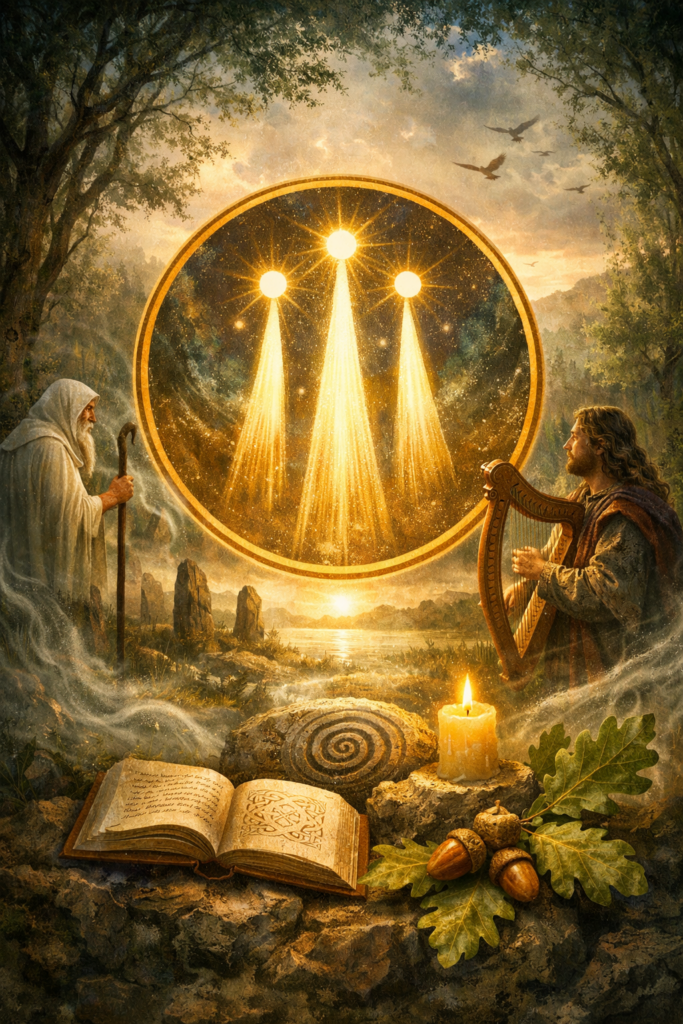
the Awen symbol with the druid Merlin and a Celtic bard

🌬️ Etymology: Breath at the Origin of Creation

The word “Awen” derives from the Indo-European root -uel (“to blow”), related to:

  • awel (breeze in Welsh)
  • awen (wind in Cornish)
  • Proto-Celtic āwenā

👉 This origin reinforces a fundamental idea: Awen is a vital breath, invisible yet creative

This concept resembles other universal traditions:

  • Prana (Hinduism)
  • Ruach (Hebrew tradition)
  • Furor poeticus (Greco-Roman world)

🧙‍♂️ Awen in the bardic and druidic tradition

In Celtic societies, bards and druids were the guardians of knowledge.

  • Bards passed down memory and wisdom through poetry and music.
  • Druids embodied philosophy, spirituality, and teaching.

👉 Awen was their common source: a sacred inspiration, received as a revelation.

This transmission was essentially oral, which explains why it is difficult to understand from a historical perspective.

🌀 Awen as a State of Consciousness

👉 Modern research often interprets Awen as an altered state of consciousness.

Comparable to a shamanic trance, it is said to allow one to:

  • gain access to profound knowledge
  • connect with the invisible world
  • channel non-rational inspiration

These states were induced through song, poetry, meditation, and rituals.

It thus becomes a lived experience, rather than a mere concept

🔥 Its symbol /|\: a universal language

The modern symbol of Awen—three rays crowned by three dots—is rich in meaning.

This symbol gained popularity in the 18th century thanks to Iolo Morganwg, a figure of the Druidic revival and founder of the National Eisteddfod of Wales (1792).

Today it is used by the Gorsedd of Bards of the Islands of Britain.

The three rays can represent:

  • man, woman, and spirit
  • earth, sea, and air
  • light, love, and truth
  • the underworld, the middle world, and the upper world
  • or even the solar cycles (solstices and equinoxes)

👉 Above all, they symbolize: balance, harmony, and enlightenment.

🔊 Awen as the primordial sound

👉 In the modern bardic tradition, it is also considered the first sound of creation. It is divided into three vibrations:

  • O (corresponding to the first part /)
  • I (corresponding to the central part |)
  • OU (corresponding to the right part \)

From that sound, rays of light are said to have emerged, giving rise to creation, the cosmic order, and life in all its manifestations.

✝️ Christianization and the Transformation of the Concept

👉 With the Christianization of the Celtic peoples, Awen was reinterpreted as a form of divine inspiration linked to the Holy Spirit.

This adaptation allowed the concept to survive, even though its pagan roots were partially transformed.

🎓 Awen in Modern Academic Research

Contemporary studies (especially in Cambrian Medieval Celtic Studies) focus on its linguistic origins, its cultural role, and its historical evolution.

Researchers are divided between viewing Awen as an authentically ancient concept and seeing it as a modern neo-Druidic reconstruction.

🌍 The Awen and its counterparts around the world

ConceptCultureMeaningMain characteristics
AwenCeltic (Welsh, Breton)Poetic inspiration, creative breathAltered state of consciousness, connection with nature
Imbas ForosnaiIrishPoetic inspiration, prophetic tranceMeditative practice, banned with Christianization
PranaHinduismVital energy, breath of lifeSpiritual force, link between body and mind
RuachHebrewDivine breath, spiritBiblical concept, divine power
Furor PoeticusGreco-romanEcstatic/poetic inspiration, creative furyAssociated with the Muses, a state of exaltation
WakaJapanesePoem, poetic inspirationArtistic expression, connection with nature

👉 Awen is part of a universal human experience.

🌿 Awen Today: Between Spirituality and the Modern Revival

The concept of Awen is widely used today in Neo-Druidism, contemporary spiritual practices, and personal development.

It is used to:

  • stimulate creativity
  • deepen meditation
  • reconnect with nature

👉 In this way, Awen becomes a tool for inner awakening and transformation.

💫 Conclusion: Awen, a Bridge Between Worlds

Awen is much more than a cultural legacy.
It is a living force, a universal creative breath.

Awen is an ancient and complex concept, deeply rooted in Celtic culture, which has evolved over the centuries through medieval texts, oral traditions, and Druidic practices. It embodies poetic and spiritual inspiration, the creative breath that connects the human with the divine and with nature. Anthropological interpretations link it to altered states of consciousness and shamanic practices, while modern research highlights its central role in Celtic culture and its contemporary adaptation in Neodruidism.

The symbol of the awen, rich in meaning, continues to inspire and fascinate, bearing witness to the enduring nature of this concept and its importance in the human quest for meaning, creativity, and spiritual connection. The awen thus remains a living bridge between the ancestral past and contemporary aspirations, between nature and the spirit, between the human and the divine.

It reminds us of something essential: inspiration is sacred and flows within each of us.

RESIDENTIAL NEPALESE HIMALAYAN SHAMANISM RETREAT – The Dhami-Jhankri Shamanic Path

Madrid – Spain – From June 25th to 28th 2026

Introducing Nepal Himalayan Dhami-Jhankri-Shamanism with Nepalese Jhankri Shaman Bhola Banstola.

Photo: Céline Godeux ©

What will you learn during the “Dhami-Jhankri Shamanic Path” retreat?

Embark on a transformative journey with Bhola Banstola, a distinguished lineage carrier of the Nepali Dhami-Jhankri Shamanic Path. This is your unique chance to immerse yourself in an ancient practice, steeped in wisdom that has been lovingly passed down through generations. Whether you are a curious beginner or an experienced practitioner, these teachings will offer you invaluable insights and guidance.

Delve into the heart of traditional Shamanism, where the rhythmic pulse of drumming and the melodic resonance of sacred mantras guide you on active narrative journeys, opening doors to profound states of awareness.

This practice is a celebration of the power of sacred songs, utterly devoid of any mind-altering substances. Shamanism stands as humanity’s oldest spiritual healing tradition, empowering us to reconcile our past, enrich our present, and illuminate our future.

The gifted Dhami-Jhankri Shamans have long harnessed their abilities to heal emotional wounds, dissolve anxiety, and nurture community resilience. During this transformative experience, participants will explore various levels of Transmission, tapping into the boundless healing energy that lies within.

You will uncover practical methods to foster self-empowerment and support others, all through the dynamic mediums of rituals, dances, chants, and drumming. Rooted in ancestral wisdom, lineage, and a deep connection to nature, Shamanism invites us to engage with local spirits, emphasizing the importance of seasonal rituals as pathways to protection and harmony. Commitment and understanding are essential to deepening our practices.

We invite you to become part of “Transmission of Laying the Foundation”, a pivotal first step into the profound exploration of this sacred tradition.

Here’s what awaits you:

  • Discover the rich roles of the Dhami-Jhankri-Shaman, both in history and contemporary contexts.
  • Create a sacred shamanic space (Thaan) and prepare traditional ritual offerings (Chadaunu) imbued with intention and respect.
  • Embark on an exploration of elemental spirits and our intimate relationship with them through guided Transmission.
  • Experience the exhilaration of active trance states through drumming and chanting, fostering deep connections without the use of mind-altering substances.
  • Co-create a healing Mandal-Rekhi that serves as a vibrant portal for wellness and transformation.
  • Gain insights into disharmony and actively engage in a collective healing ritual that nurtures the group.
  • Participate in the empowerment of Bhumi-Devi (Mother Earth), reinforcing our bond with the planet.
  • Learn the sacred art of creating Thaan (altars) that honor the spirits of nature and ancestors.
  • Connect deeply with Kul (lineage protectors), Pitri (ancestors), and Ista Deo (guiding spirits), anchoring your spiritual journey.
  • Access personal protection, healing, and empowerment that resonates with your unique essence.
  • Conclude with the profound ritual of Siir Uthaune (raising the spirit), embracing the fullness of your experience.

Join us on this extraordinary odyssey into the rich tapestry of Nepali-Himalayan Dhami-Jhankri shamanic wisdom, and unlock the limitless possibilities that await you in healing and learning.

Your journey begins here.

Photo: Céline Godeux ©

Who is leading the retreat?

Learn Nepali shamanism directly from an established, authentic lineage that has been passed down for millennia, remaining a living tradition uninterrupted. Bhola Banstola, a 27th Generational Shaman, has been teaching internationally for decades. He has established himself as one of the rare teachers of traditional Shamanism, inspiring people from all cultures by teaching them the practices his family lineage has used successfully for many thousands of years. He is offering his instruction and wisdom through Zoom, with live sessions, but also through retreats in different countries of Europe and pilgrimages in Nepal.

Photo: Bastien Laure ©

More info about Bhola:

www.BholaBanstola.com
www.nepalishamanism.com

Is it right for you?

This course is designed for individuals who are willing to experience and learn firsthand the traditional shamanic path and then adapt those methods and practices to their own unique circumstances, culture, and environment. By participating in this course, you will not only gain a deep understanding of Nepalese Shamanism but also experience personal and spiritual growth. This course will be done through a 4-day immersion teaching, with 3 nights and shared meals.

Are there any previous requirements to access the retreat?

No specific requirement is asked. Nonetheless, as a suggestion, you can start your journey with the books written by Bhola (More information: https://bholabanstola.com/books/)

 “Working with the Elemental Spirits – The Five Elements and Shamanism in Nepal”

“The Nepalese Shamanic Path – An experiential guide to the shamanic spiritual practices of the Himalayas shared by a 27th-generation Nepalese shaman”

What is included in the retreat?

In the price of the retreat, are included:

  • Bhola’s teachings from Thursday to Sunday
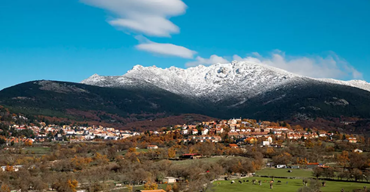
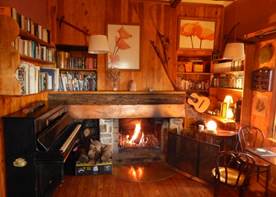
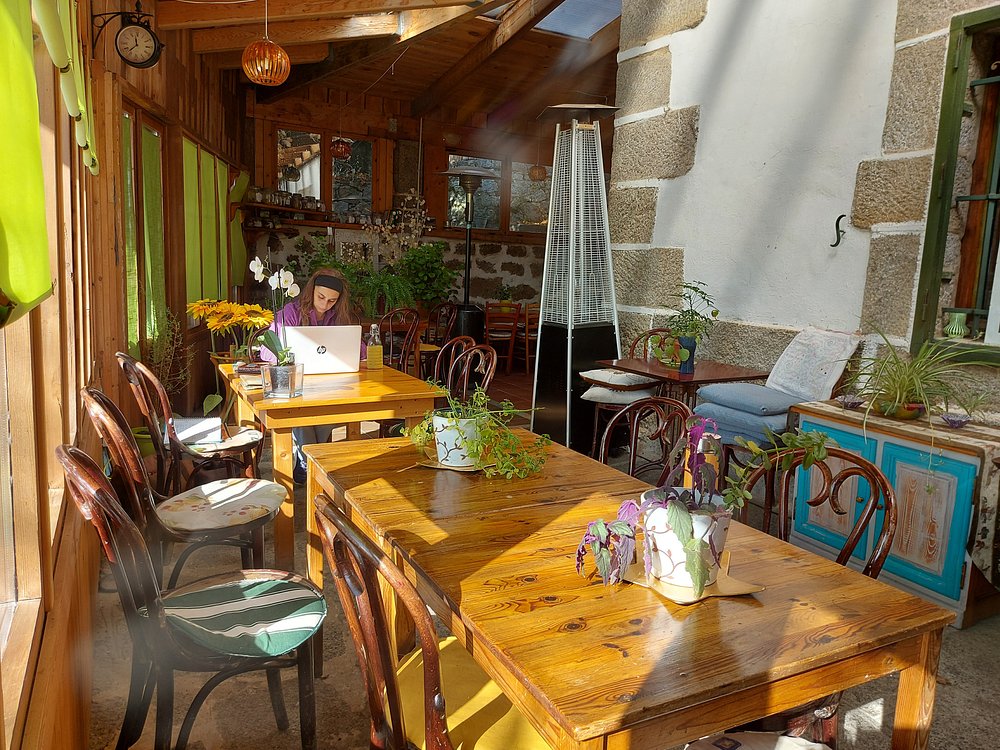
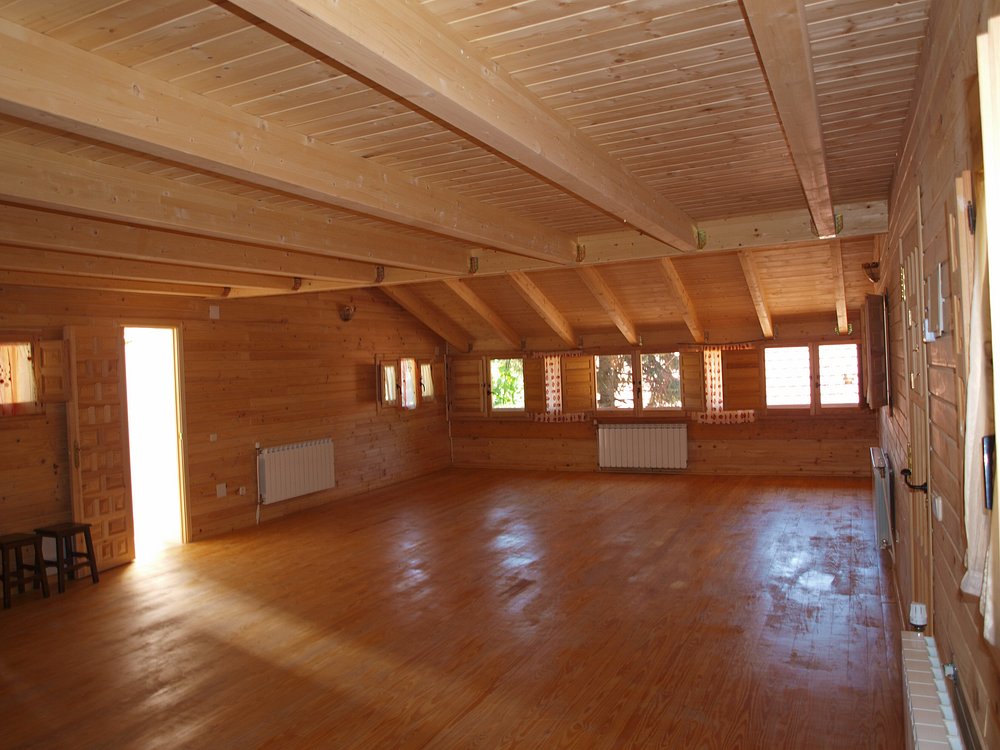
  • Accommodation: 3 nights in shared rooms (there is no individual room available) in simple accommodation, cabins, typical mountain rooms, in a wooded setting on a 17,000 m² estate, open to nature and the mountains (Cercedilla is located at an altitude of 1,118 m).
  • Vegetarian meals from Thursday dinner to Sunday lunch. If you have any food allergies or require a special menu due to medical reasons, please consult us to see if there will be any additional charges.
  • Tea breaks

What is NOT included in the retreat?

Are not included in the retreat price:

  • Transfer from Madrid City to Cercedilla (around 3€/trip by bus or 5,50€/trip by commuter train)
  • Towels or personal hygiene products
  • Work materials (writing): each person may bring their own notepad and pens if they wish to take notes (not compulsory).

Teachings will start on Thursday, June 25th at 4pm and will finish on Sunday June 28th at 4pm.

You are welcomed on site (Cercedilla, mountain village of the Sierra de Guadarrama) on June 25th from 3pm and you will leave the site no later than Sunday June 28th at 4:30pm.

To get to the site in Cercedilla, around 50km from Madrid, you can come by:

  • bus (autobus interurbano) from Madrid – Moncloa bus station: bus 684, up to C/ Emilio Serrano in Cercedilla (around 50 min. to 1h from Moncloa Station)
  • Commuter train (tren de Cercanias) from many stations like Chamartin, Nuevos Ministerios, Recoletos, Atocha: line C8 (around 75 minutes from Chamartin station)
  • Car (you will not be able to park on site, but you can search for a parking place near the train station) or taxi / Uber (around 50min to 1h depending on traffic and where you come from within Madrid city)

Recommendation: use Citymapper app or similar to get detailed information on public transportation.

A WhatsApp group will be created for participants to follow up on logistics (like car sharing), teachings and sharing.

How to register and contribute financially?

You can register sending an email to energiaspirit[@]gmail.com.

The full retreat has a humble contribution of 555 euros (VAT included) for all teachings, meals and 3 nights (transfer and remittance at your own expense). We ask for a deposit of 295 euros to secure your place (non-refundable). Additional donations are welcome.

For further details or any other questions, please get in touch with Céline via email energiaspirit[@]gmail.com.


We look forward to welcoming you to these Dhami-Jhankri teachings, with their deep roots in the Nepalese Himalayas and practiced for millennia. It’s Nepal’s living culture and heritage.

Namaste