Ostara / Eostre: The Arrival of Spring in the Celtic Calendar

Around March 20, in the Northern Hemisphere, we celebrate the return of spring. It is a moment that marks the balance between day and night, the equinox. It is also the return of light and the return of the earth’s fertility, with the first shoots beginning to emerge from the ground, buds timidly appearing on the branches of shrubs and trees, chicks leaving their nests, and hares leaping into the grass to court one another. Light triumphs over darkness. The days are sweeter, longer, and livelier. Energy and passion are two other symbols of this period. The two polarities—feminine (moon-night) and masculine (sun-day)—balance each other and unite to make life fruitful.
ostara

After a harsh winter, the rebirth of life and the Earth is associated with the Anglo-Saxon goddess of fertility: Eostre, often linked to the goddesses of the Dawn—Aurora for the Romans and Eos for the Greeks. These goddesses were thus entrusted with the task of ushering in the morning, letting in the light of day. As a symbol of Dawn and Aurora, the associated direction is, in fact, the East.

The Spring Equinox is also associated with the Germanic goddess Ostara, whose name derives from the word “ost,” meaning “East.” Ostara is the goddess of fertility, the earth, nature, and youth.

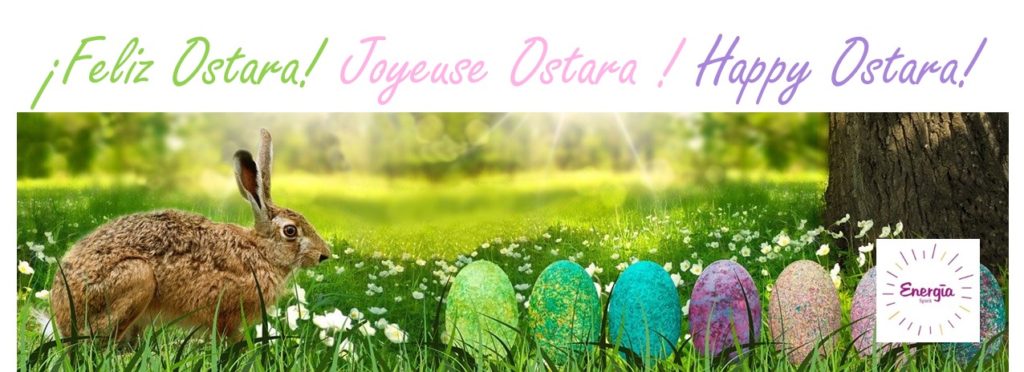
The animals associated with this period of fertility are chicks, young rabbits, ducklings, and young animals. The rabbit or hare, formerly associated with the moon, is also a symbol of fertility.

The colors associated with Ostara are the yellow of the sun and the green of nature.

Rituals tailored for these days of renewal

  • Spring cleaning began with Imbolc in early February. Now is the time to finish that big house cleaning—in every area of your life and on every level—by sweeping away stagnant and even harmful energies. So grab your broom and sweep away, both symbolically and physically, whatever you no longer need from inside your house or apartment. Sweep each room with the broom, starting from the corners opposite the door, to sweep them toward the room’s doorway, and then sweep them out through the front door with gratitude. Next, you can burn incense (Copal, Benzoin…) or smudge with white sage, rosemary, etc., in each room, and then air them out. And don’t forget to pass the sage or incense around yourself as well to free yourself too.
  • The celebration of life and fertility comes to life with eggs that you can paint in vibrant colors. Once used in sacred rituals before being eaten, eggs represent the genesis of the world, where life emerges from darkness to discover the light.
  • To celebrate the Earth’s awakening in the coming days, you can also take a walk in nature, barefoot, gather the first fresh flowers of the year, and express your gratitude for their blooming, their blossoming. Observe the buds emerging, listen to the buzzing of insects. You can also tend to your garden, plant seeds, or simply enjoy the warmth of the sun. In any case, take this moment to ground yourself, and take a long, deep breath to welcome this renewal.
  • Ostara is also an ideal time to spark new projects, to create, to initiate change. So take your best pen and draw your desires, affirm your desires, decree your desires. Do this by including as many details as possible: date, place, images, sound, sensation, surroundings…
  • Take a moment to meditate while sitting or lying under a tree and enjoy the present moment, observing your surroundings, smiling at life.

#ostara #eostre #ancestraltradition #rebirth #growth #life #fertility #nature #equinox #spring
 🌿Awen: The Power of the Sacred Celtic Breath

🧠 A Brief Definition of “Awen”

Awen is a Celtic concept that refers to a breath of divine inspiration. It symbolizes a creative spiritual energy that connects humans with nature and the divine, and plays a fundamental role in the tradition of the bards and druids..

⏱️ Reading time: 6-8 min

✨Introduction: Awen, an Ancestral Breath That Lives On

The concept of Awen is one of the most fascinating pillars of Celtic spirituality. At once poetic inspiration, creative force, and divine breath, it has endured through the centuries, from the oral traditions of the bards to contemporary Neo-Druidic practices.

But Awen is not limited to a simple spiritual idea: it constitutes a genuine bridge between the human, nature, and the divine, as studied in medieval texts.

📜 Origins: Between Ancient Texts and Oral Tradition

📖 The earliest written records

Awen appears as early as the 9th century in Nennius’s *Historia Brittonum*, where it is associated with the figure of Talhaern Tad Awen, highlighting its importance in the Welsh bardic tradition.

But it is above all in the Book of Taliesin (13th–14th centuries) that the concept takes on its full significance. This manuscript contains several instances of the term, as well as related expressions such as ogyrven, which refer to sacred poetic inspiration.

An emblematic fragment from the Hanes Taliesin manuscript illustrates this idea (excerpt from the legendary poem Angar Cyfundawt):

“I sing of poetic knowledge; from the deep I wield it (Awen a ganaf, o dwfyn ys dygaf)
It is a flowing river; I know it must be so (Auon kyt beryt : gogwn y gwrhyt)
I know it ebbs and flows (Gogwn pan dyueinw, gogwn pan dyleinw)
I know when it overflows and when it dries up (Gogwn pan dillyd, gogwn pan wescryd).
I know how many creatures live beneath the sea. (Gogwn pet pegor, Yssyd y dan vor.)”

In it, Awen is described as a living current, an energy in motion, comparable to a spiritual river. Awen is the breath of bardic inspiration, while also reflecting depth.

the Awen symbol with the druid Merlin and a Celtic bard

🌬️ Etymology: Breath at the Origin of Creation

The word “Awen” derives from the Indo-European root -uel (“to blow”), related to:

  • awel (breeze in Welsh)
  • awen (wind in Cornish)
  • Proto-Celtic āwenā

👉 This origin reinforces a fundamental idea: Awen is a vital breath, invisible yet creative

This concept resembles other universal traditions:

  • Prana (Hinduism)
  • Ruach (Hebrew tradition)
  • Furor poeticus (Greco-Roman world)

🧙‍♂️ Awen in the bardic and druidic tradition

In Celtic societies, bards and druids were the guardians of knowledge.

  • Bards passed down memory and wisdom through poetry and music.
  • Druids embodied philosophy, spirituality, and teaching.

👉 Awen was their common source: a sacred inspiration, received as a revelation.

This transmission was essentially oral, which explains why it is difficult to understand from a historical perspective.

🌀 Awen as a State of Consciousness

👉 Modern research often interprets Awen as an altered state of consciousness.

Comparable to a shamanic trance, it is said to allow one to:

  • gain access to profound knowledge
  • connect with the invisible world
  • channel non-rational inspiration

These states were induced through song, poetry, meditation, and rituals.

It thus becomes a lived experience, rather than a mere concept

🔥 Its symbol /|\: a universal language

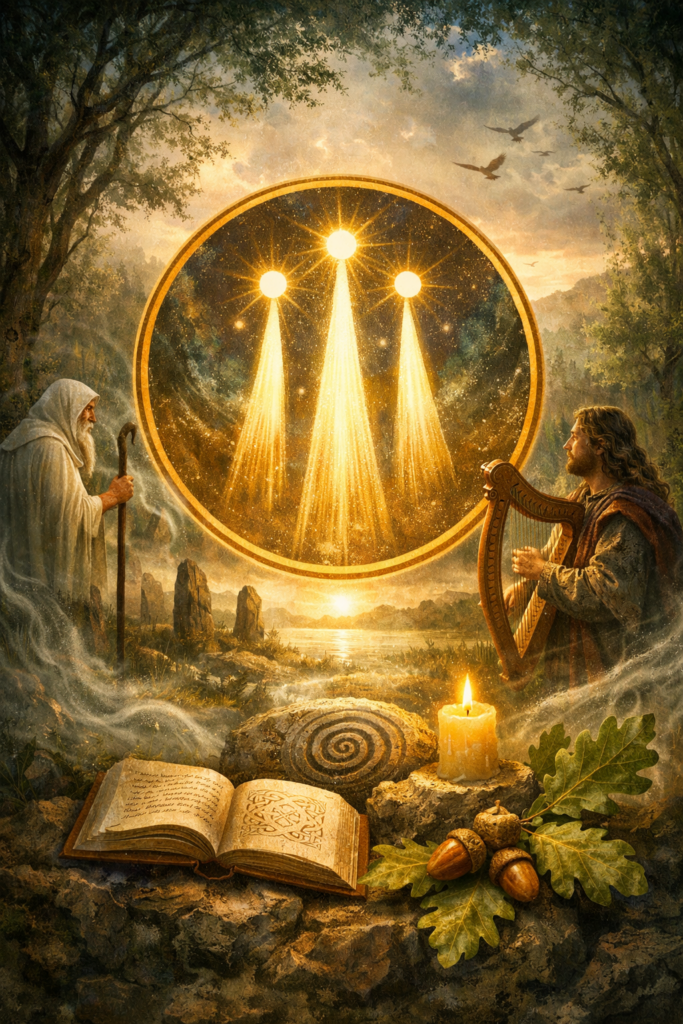
The modern symbol of Awen—three rays crowned by three dots—is rich in meaning.

This symbol gained popularity in the 18th century thanks to Iolo Morganwg, a figure of the Druidic revival and founder of the National Eisteddfod of Wales (1792).

Today it is used by the Gorsedd of Bards of the Islands of Britain.

The three rays can represent:

  • man, woman, and spirit
  • earth, sea, and air
  • light, love, and truth
  • the underworld, the middle world, and the upper world
  • or even the solar cycles (solstices and equinoxes)

👉 Above all, they symbolize: balance, harmony, and enlightenment.

🔊 Awen as the primordial sound

👉 In the modern bardic tradition, it is also considered the first sound of creation. It is divided into three vibrations:

  • O (corresponding to the first part /)
  • I (corresponding to the central part |)
  • OU (corresponding to the right part \)

From that sound, rays of light are said to have emerged, giving rise to creation, the cosmic order, and life in all its manifestations.

✝️ Christianization and the Transformation of the Concept

👉 With the Christianization of the Celtic peoples, Awen was reinterpreted as a form of divine inspiration linked to the Holy Spirit.

This adaptation allowed the concept to survive, even though its pagan roots were partially transformed.

🎓 Awen in Modern Academic Research

Contemporary studies (especially in Cambrian Medieval Celtic Studies) focus on its linguistic origins, its cultural role, and its historical evolution.

Researchers are divided between viewing Awen as an authentically ancient concept and seeing it as a modern neo-Druidic reconstruction.

🌍 The Awen and its counterparts around the world

ConceptCultureMeaningMain characteristics
AwenCeltic (Welsh, Breton)Poetic inspiration, creative breathAltered state of consciousness, connection with nature
Imbas ForosnaiIrishPoetic inspiration, prophetic tranceMeditative practice, banned with Christianization
PranaHinduismVital energy, breath of lifeSpiritual force, link between body and mind
RuachHebrewDivine breath, spiritBiblical concept, divine power
Furor PoeticusGreco-romanEcstatic/poetic inspiration, creative furyAssociated with the Muses, a state of exaltation
WakaJapanesePoem, poetic inspirationArtistic expression, connection with nature

👉 Awen is part of a universal human experience.

🌿 Awen Today: Between Spirituality and the Modern Revival

The concept of Awen is widely used today in Neo-Druidism, contemporary spiritual practices, and personal development.

It is used to:

  • stimulate creativity
  • deepen meditation
  • reconnect with nature

👉 In this way, Awen becomes a tool for inner awakening and transformation.

💫 Conclusion: Awen, a Bridge Between Worlds

Awen is much more than a cultural legacy.
It is a living force, a universal creative breath.

Awen is an ancient and complex concept, deeply rooted in Celtic culture, which has evolved over the centuries through medieval texts, oral traditions, and Druidic practices. It embodies poetic and spiritual inspiration, the creative breath that connects the human with the divine and with nature. Anthropological interpretations link it to altered states of consciousness and shamanic practices, while modern research highlights its central role in Celtic culture and its contemporary adaptation in Neodruidism.

The symbol of the awen, rich in meaning, continues to inspire and fascinate, bearing witness to the enduring nature of this concept and its importance in the human quest for meaning, creativity, and spiritual connection. The awen thus remains a living bridge between the ancestral past and contemporary aspirations, between nature and the spirit, between the human and the divine.

It reminds us of something essential: inspiration is sacred and flows within each of us.