🌞 What is Holi in Nepal?
In Nepal, Holi is called Fagu Poornima. This festival takes place during the full moon, in the Hindu calendar month Phagun, that is between early March and early April.
It marks the end of the long winter months. The return of the sun and higher temperatures corresponds to this moment of celebration.
Thus, Holi celebrates the growing light and the renewal of nature.
🔥 The fire ceremony: celebrating the light
First of all, a fire ceremony takes place on the night preceding the celebrations.
In each village, a large pile of wood is built. Each household brings logs to form a collective fire.
The oldest person in the village, or the one who leads the ceremony, lights the fire. This can be a dhami – jhankri, a Nepalese shaman.
Around the flames, the community gathers. Participants play traditional music with drums and trumpets. Then, voices rise and accompany the dances around the fire.
This moment allows to:
- let go of darkness and cold
- bring healing energies
- strengthen bonds within the community
🏵️ The sacred pole ritual in Kathmandu
In Kathmandu, the festival begins with the raising of a ceremonial pole called chir. This pole is made from a pine tree cut in the district of Bhaktapur. It is then transported in ceremony to Kathmandu. It is erected in Basantapur, on Durbar Square.
The top of the pole is surrounded by strips of colored fabric. At its base, oil lamps are lit and placed on a ground covered with cow dung.
Participants also tie colored threads around the trunk.
This pole symbolizes both the union of masculine and feminine energies and a banner of victory to welcome spring.
The fabrics represent the garments of the Gopinis (devotees of Krishna).
🌈 The day of colors: celebrating life
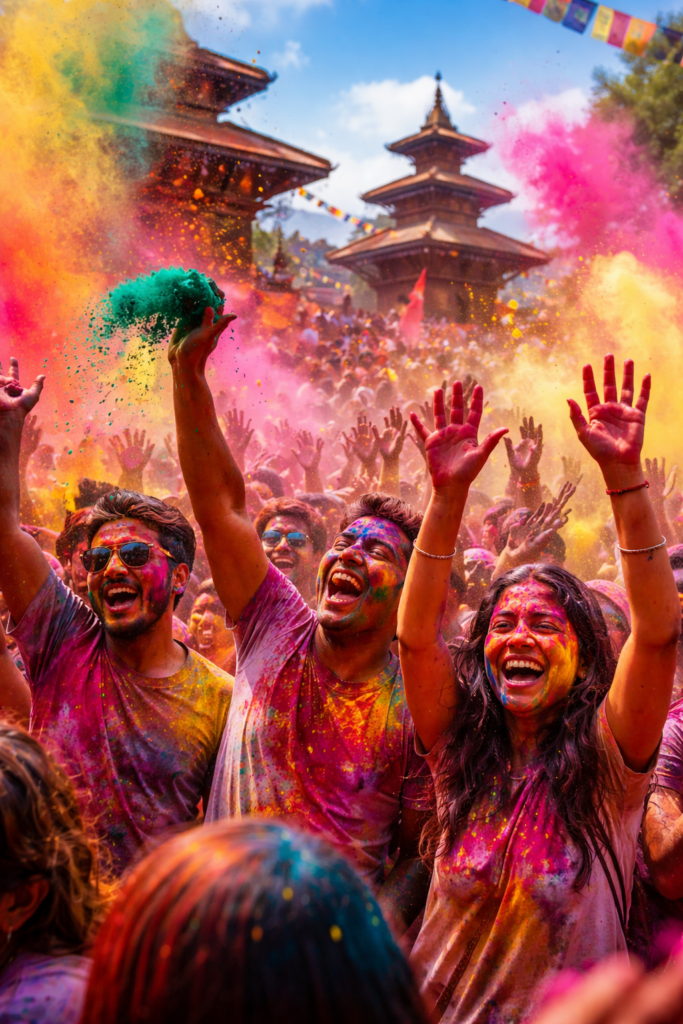
The next day, the festival becomes joyful and colorful. It celebrates the defeat of darkness by the forces of light.
It also symbolizes the union of Earth, Dharti Mata, and Sky, Akash. This union marks the season of fertility of nature.
To celebrate this moment, participants throw colored powders at each other. They move in small groups and cover themselves with colors.
🔥 The final of the festival: fire and protection
At the end of the festival, the pole is lowered.
The crowd rushes to collect the strips of fabric. They are considered protective amulets against evil spirits.
Then, the pole is transported to Tundikhel, a large square in Kathmandu. It is burned in a large fire, into which women throw coconuts.
Finally, participants bring home embers and ashes to purify their house.
📜 What is the origin of Holi in Nepal?
Holi was originally a festival celebrating spring, good harvests and fertility.
The first mentions date back to the 4th century. It is also described in a 7th-century Sanskrit play titled Ratnavali, written by Harsha.
Today, Holi is mainly associated with several legends of Hindu mythology.
The first legend is that of Holika and Prahlada, children of Hiranyakasyapu.
Hiranyakasyapu considered himself the most powerful being in the universe and wanted everyone to worship only him. Prahlada, on the other hand, was a devotee of the god Vishnu.
Hiranyakasyapu tried many times to convince his son to worship him, but failed miserably. Prahlada therefore continued to worship the god Vishnu. He tried to kill him several times, without success.
Hiranyakasyapu then plotted to assassinate his 5-year-old son. He ordered Holika, his sister, to kill Prahlada. Holika was supposed to be protected from fire thanks to a fireproof robe. And finally, she took Prahlada into the flames.
However, because of his faithful devotion to the god Vishnu, the god Krishna came to his rescue: the prince came out unharmed, while Holika burned in his place.
Holika Dahan, which means “the end of Holika”, is today known as Holi. People still celebrate the death of Holika with colors. They make a straw replica of Holika and burn it during the Holi festival.
💕 The story of Krishna and Radha
It is said that Krishna constantly complained to his mother, Yasodha, and that all his friends teased him by calling him “the dark one” (Kala).
It is said that he asked Yasodha why he was dark while all his friends (the Gopinis, including his beloved Radha) had fair skin.
Yasodha then gave Krishna different colors and asked him to throw them on the faces of all the Gopinis so that they too would have dark skin like him.
Krishna brought the colors and applied them to all the Gopinis. The Gopinis loved these colors, as they were all deeply in love with Krishna and enjoyed this moment.
This is one of the legends explaining the use of colors during Holi festivities.
Today, colors symbolize:
- blue for Krishna
- red for love and fertility
- green for spring and renewal
- yellow for turmeric and prosperity
🌿 Create your own renewal ceremony
This ceremony can be performed at the beginning of spring or at any time when you wish to mark the end of one cycle and the beginning of another.
It can celebrate:
- the end of an important project
- a new relationship
- a birth
- a return to health
It is about honoring these events and the renewal that accompanies them.
You can choose to celebrate this passage alone or with your loved ones.
🌍 In conclusion, Holi in Nepal…
Holi is the most colorful festival in Nepal, and very probably on the continent.
It celebrates renewal, light and the cycles of life. Through fire, colors and rituals, it marks the passage toward a new beginning.
❓ FAQ / Frequently Asked Questions – Holi in Nepal
➤ When does Holi take place in Nepal?
Holi takes place during the full moon, in the Hindu calendar month Phagun, between early March and early April.
➤ What does Holi symbolize?
Holi symbolizes the return of light, fertility and renewal.
➤ Why is a fire lit?
The fire commemorates the death of Holika and symbolizes purification.
➤ Why are colors used?
Colors celebrate fertility, joy and the legend of Krishna and Radha.